

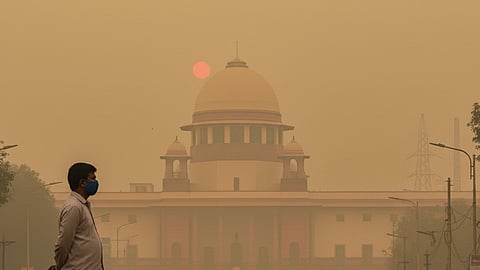

The Supreme Court refused to interfere with respect to the decision of Delhi government to direct shutting schools or hybrid model of schools. Supreme Court on Wednesday orally observed that the measures taken by authorities so far have been a “total failure” in effectively curbing the rising levels of air pollution in the Delhi-NCR region. A Bench led by Chief Justice of India Surya Kant remarked that any meaningful reduction in pollution would require broader and long-term planning rather than ad-hoc responses.
With respect to various petitions highlighting the inadequacy of recent measures aimed at protecting children, such as the Delhi government’s directives to shut schools or allow them to function in a hybrid mode, the top court noted that these were merely temporary policy decisions taken by the authorities to mitigate health risks.
The Supreme Court bench refused to interfere with respect to the decision of Delhi government to direct shutting schools or hybrid model of schools. “The short-term measures are only to provide temporary protection to children and elderly persons. These are purely interim policy decisions. At best, they can be viewed as an extension of vacations, as schools are anyway scheduled to remain closed for 10 to 15 days during the winter,” the Court observed.
CJI Kant said the air pollution crisis has become an annual feature, adding that seems that a long term plan need to be evolved and given effect in phased manner. The top court requested the CAQM to revisit the long term measures and address the following issues, according to updates from the hearing LiveLaw shared:
(1) the urban mobility;
(2) cleaners industry and energy;
(3) stubble burning and modes and manner of incentivising the farmers to stop stubble burning and rather to use that for multiple purposes;
(4) regulation of construction activities and provision of alternative employment when the activities are suspended
(5) pollution generating from household activities and measures; (6) increasing green cover;
(7) citizen awakening programme and the voluntary giving up of (inaudible) contributing directly / indirectly contributing to air pollution
(8) strengthening of public transport system and ensuring citizen-centric approach
(9) any other area may be also identified by the CAQM
Meanwhile, the Supreme Court on Wednesday ended protection to end-of-life (EOL) vehicles in Delhi-NCR with poor emission standards of BS-III and below. The court passed the order on recommendation of CAQM modifying its August 12 order which extended protection from any coercive action to all EOL vehicles in Delhi and NCR.
