

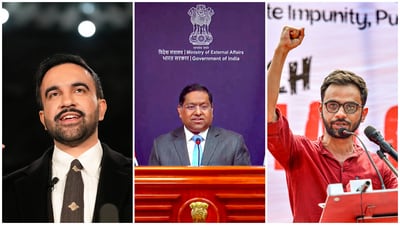

On Monday, the Supreme Court denied bail to student activists Umar Khalid and Sharjeel Imam in the alleged larger conspiracy behind the 2020 Delhi riots. Days after the Supreme Court denied bail to Umar Khalid and Sharjeel Imam, two main accused in the 2020 Delhi riots case, the Ministry of External Affairs reacted to newly sworn-in New York mayor Zohran Mamdani’s hand-written note to Khalid and said that “expressing personal prejudices do not behove those in office”.
In the note addressed to Khalid, Mamdani had written, “I think of your words on bitterness often, and the importance of not letting it consume one’s self. It was a pleasure to meet your parents. We are all thinking of you.” The note was shared on social media by Khalid’s partner, Banojyotsna Lahiri, on January 1, which is also when Mamdani took oath as the first Muslim mayor of New York city. “Zohran Mamdani writes to Umar Khalid. December 2025,” Lahiri captioned the photo of the note.
Expressing a mild disapproval for Mamdani’s letter, Jaiswal said on Friday during the weekly press conference that public representatives are expected to be “respectful of judiciary in other democracies”. “We expect public representatives to be respectful of the independence of the judiciary in other democracies. Expressing personal prejudices do not behove those in office. Instead of such comments, it would be better to focus on the responsibilities entrusted to them,” the MEA spokesperson said.
On Monday, the Supreme Court bench of justices Aravind Kumar and NV Anjaria denied bail to student activists Umar Khalid and Sharjeel Imam in the alleged larger conspiracy behind the 2020 Delhi riots, however, released the five other co-accused, holding that continued incarceration of the latter was not indispensable to the conduct of a fair trial at the present stage. The five co-accused who were released on bail were Gulfisha Fatima, Meeran Haider, Shifa Ur Rehman, and Mohd. Saleem Khan and Shadab Ahmad.
The top court’s refusal to grant bail to student activists Umar Khalid and Sharjeel Imam in the 2020 Delhi riots conspiracy case rests on a key judicial finding that the prosecution material, taken at face value, places the two on a “qualitatively different footing” from other accused, attributing to them “central”, “formative” and “strategic” roles in the alleged conspiracy rather than local or episodic participation.
