

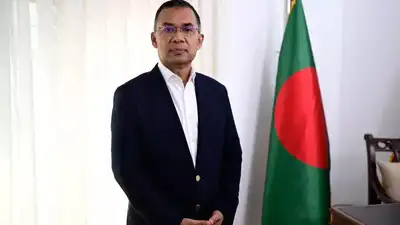

With Tarique Rahman swearing-in next week, all eyes are on Bangladesh’s next move vis-à-vis former Prime Minister Sheikh Hasina and her country of exile, India. The Bangladesh election has paved the way for the return of Tarique Rahman and his Bangladesh Nationalist Party (BNP) to power after over two decades in Bangladesh. The February 12 elections has put an end to the nineteen months of political vacuum in Dhaka since the fall of Sheikh Hasina’s Awami League government following students-led protests in 2024.
With Tarique Rahman swearing-in likely next week, all eyes are on Dhaka’s next move vis-à-vis former Prime Minister Sheikh Hasina and her country of exile, India. After BNP’s two-thirds mandate in general elections, which concluded on Friday, Tarique’s party has given mixed signals to India on bilateral ties and Hasina’s extradition.
In his address a day after Friday’s win, Tarique Rahman used his inaugural address to call for unity, with a stress on democratic values. He said Bangladesh was about to begin a new journey “in a situation marked by a fragile economy left behind by the authoritarian regime.” “This victory belongs to Bangladesh. This victory belongs to democracy. This victory belongs to the people who aspire to and have sacrificed for democracy. From today, we are all free, with the true essence of freedom and rights restored,” he said in the address.
To a question on how the BNP leader sees India-Bangladesh ties, Tarique was quick to highlight “Bangladesh First” agenda. “The interests of Bangladesh and its people will determine our foreign policy,” Rahman said in response to the question. He maintained earlier that the BNP government would maintain balanced ties with neighbours like India, China and Pakistan and not treat any country as its “master”.
India looks to reset Bangladesh ties
Soon after BNP’s victory on Friday, Prime Minister Narendra Modi was one of the first leaders to dial Rahman and congratulate him on BNP’s victory. In the call to Tarique, PM Modi reaffirmed India’s continued commitment to peace and prosperity of the two neighbours and highlighted “deep-rooted historical and cultural ties”.
“Delighted to speak with Mr. Tarique Rahman. I congratulated him on the remarkable victory in the Bangladesh elections. As two close neighbours with deep-rooted historical and cultural ties, I reaffirmed India’s continued commitment to the peace, progress, and prosperity of both our peoples,” PM Modi’s social media post read. The BNP acknowledged Modi’s congratulatory message and underlined its intent to maintain cooperative relations with India.
“We look forward to engaging constructively with India to advance our multifaceted relationship, guided by mutual respect, sensitivity to each other’s concerns, and a shared commitment to peace, stability, and prosperity in our region,” the BNP social media post read. A BNP leader has also expressed hope that PM Modi would be invited for Tarique’s swearing-in ceremony.
BNP’s next move on Hasina?
On the day of Tarique’s victory, senior BNP leader Salahuddin Ahmed reaffirmed his party’s demand for the extradition of Sheikh Hasina from India. Hasina has been living in India since August 5, 2024, after student-led protests forced her resignation and exit from Bangladesh. In November 2025, Bangladesh’s International Crimes Tribunal (ICT)convicted her in absentia in a crimes-against-humanity linked to the crackdown on 2024 protest and awarded her a death sentence.
Dhaka has demanded that New Delhi hand Hasina over to Bangladesh under a bilateral extradition treaty. “We always press for her extradition according to the law. This is between the foreign ministries of the two countries. We also asked the government of India to please send her back to face trial in Bangladesh,” Salahuddin added. Earlier in the day, Tarique Rahman too spoke on Hasina issue and said the extradition of the deposed prime minister “depends on the legal process.”
Tarique was asked whether the BNP would seek Hasina’s extradition from India, to which the PM-elect said, “That depends on the legal process.” Hasina’s party, Awami League, was barred from participating in the February 12 elections. Hasina has called the recent polls a “well-planned farce”, adding that the low turnout proves rejection of the general election. The Bangladesh Election Commission said the turnout was 59 percent across 299 constituencies out of 300 in which voting took place. BNP secured 209 seats, while its allies won three more seats.
