
PM Modi, Macron renew defence pact, launch H125 assembly line, boost AI, critical minerals, strategic autonomy under upgraded India-France partnership. India and France on Tuesday upgraded their ties to a special global strategic partnership and took several steps to deepen cooperation in defence, technology, critical minerals and energy, as Prime Minister Narendra Modi and President Emmanuel Macron projected the bilateral partnership as a force for global stability and progress in a turbulent era.
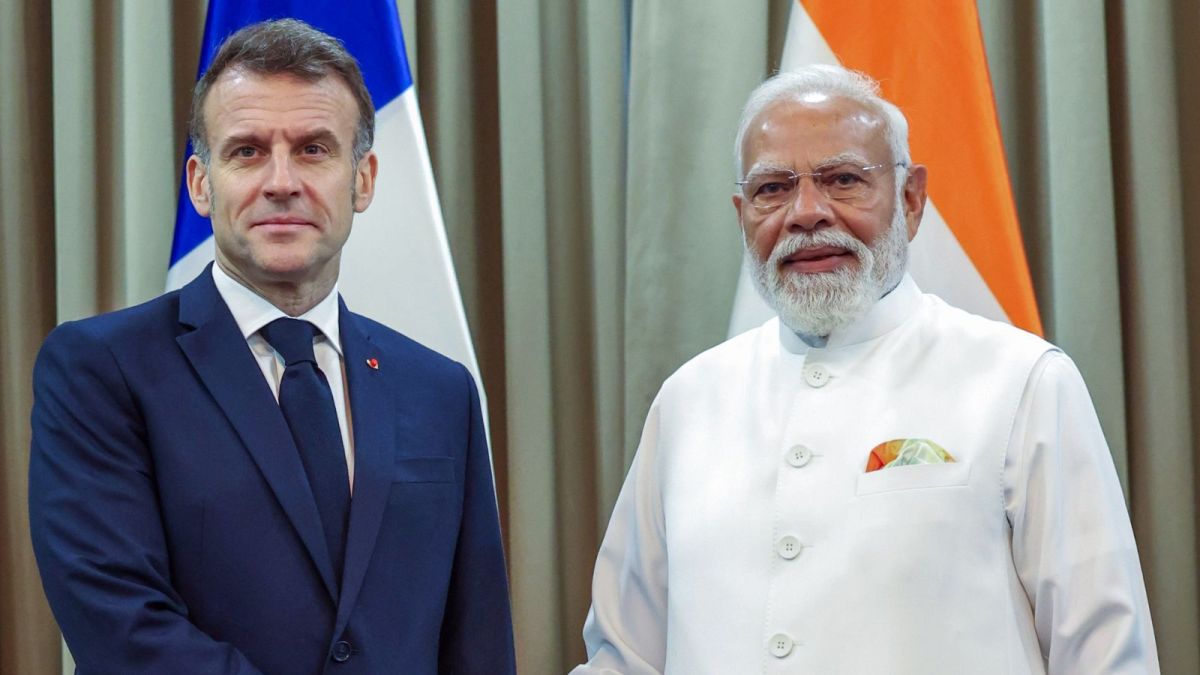
Modi met Macron, who is on a three-day visit to India, in the financial hub of Mumbai for talks focused on bilateral cooperation across a wide range of areas and measures to protect the strategic autonomy of both countries amid turbulence and uncertainty on the global stage. The leaders emphasised the need for a multipolar world and opposed hegemony during a joint media interaction.
Among the key outcomes were measures to bolster security ties, including the renewal of a defence cooperation agreement, inauguration of an assembly line for H125 helicopters in Karnataka, creation of a joint venture between Bharat Electronics Limited (BEL) and France’s Safran to produce Hammer missiles, and reciprocal deployment of officers at Indian Army and French Land Forces establishments.
“France is one of India’s oldest strategic partners…Based on this trust and shared vision, today we are establishing our relationship as a special global strategic partnership,” Modi said, speaking in Hindi. “This partnership is not just strategic. In today’s turbulent era, it is a partnership of global stability and global progress.”
Macron pointed to a “remarkable acceleration” of ties in response to the “changing international order” and said both sides do not want to be subjected to “any form of hegemony”. “This relationship is one of trust, openness and ambition,” Macron said, adding that both sides charted many new paths over the past eight years by working on issues ranging from the Indo-Pacific region to technology, with “no hegemony”. He highlighted bilateral cooperation on the India-Middle East-Europe Economic Corridor (IMEC), nuclear energy and artificial intelligence (AI), and said the two countries want to give the world an AI model that respects people and different cultures, has transparent and open algorithms, and can be used to tackle big challenges in line with the UN Charter.
Modi said the “largest and most ambitious” free trade agreement between India and the European Union (EU) will give unprecedented momentum to relations with France, and that the two sides are concluding an agreement to avoid double taxation that will also promote mutual investments and mobility. The two sides also launched the India-France Year of Innovation to connect industries and innovators in fields such as defence, clean energy, space and emerging technologies and to strengthen people-to-people contacts. “We will build strong networks between startups and MSMEs. We will facilitate exchanges between our students and researchers. Along with this, we will create new centres for joint innovation,” Modi said.
To strengthen cooperation in critical minerals, biotechnology and advanced materials, the two sides launched the Indo-French Centre for AI in Health, the Indo-French Centre for Digital Science and Technology, and the National Centre of Excellence for Skilling in Aeronautics. However, the most significant outcomes related to defence and security, where France has emerged as one of India’s closest partners in Europe. Macron’s visit came days after the Indian defence ministry’s initial approval for a major order of 114 Rafale jets for the Indian Air Force. The two leaders virtually inaugurated the assembly line for H125 helicopters set up at Vemagal in Karnataka by Tata Advanced Systems and Airbus.
Modi described the helicopter assembly line as “another shining example of this deep trust” and said: “We are proud that India and France will jointly manufacture the world’s only helicopter capable of flying to the heights of Mount Everest, and we will also export it to the entire world.” “France wants to be a trusted partner of India,” Macron said, pointing to joint defence programmes such as the supply of Rafale jets, Scorpene submarines, the helicopter assembly line, and the joint development of engines for fifth-generation fighter jets. He said France believes in increased transfer of technology to India as part of the shared goal of strategic autonomy.
The fight against terrorism and global issues such as the situation in West Asia and the Russia-Ukraine conflict also figured in the talks between the two leaders, with Modi reiterating that the India-France partnership is a “force for global stability” in a world of uncertainty. “We will continue to strengthen efforts for stability and prosperity through multilateralism, dialogue and diplomacy,” he said.
“Whether in Ukraine, West Asia or the Indo-Pacific, we will continue to support all efforts for peace in every region. It is our shared commitment to eradicate terrorism in all its forms and manifestations,” Modi said. Macron emphasised the need for the two sides to work together to stop attacks on civilian infrastructure and people in Ukraine, and said he had invited Modi to participate in the G7 Summit to be hosted by France.
The list of 21 agreements and outcomes finalised by the two sides included the launch of an annual foreign ministers’ dialogue to review ties and the implementation of the Horizon 2047 Roadmap, launch of the India-France Innovation Network, creation of a joint advanced technology development group, cooperation in critical minerals, setting up of a centre on advanced materials, a memorandum of understanding for scientific collaboration between India’s Department of Science and Technology and France’s National Centre for Scientific Research (CNRS), establishment of an Indo-French Centre for Digital Sciences and Technology, and cooperation in research and development on infectious diseases and global health.
