

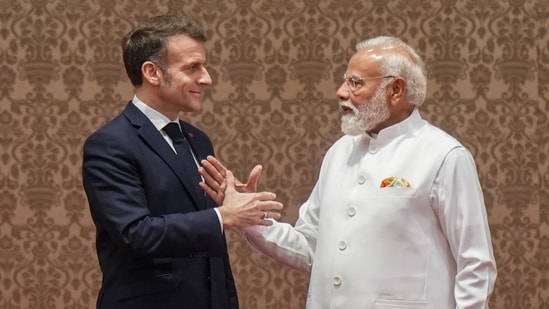

“It is the same city where Veer Savarkar jumped into the sea to escape the British. His action symbolised his unwavering resolve,” said PM Modi. When Prime Minister Narendra Modi met French President Emmanuel Macron in Mumbai on Tuesday, the Indian PM listed the late VD Savarkar and a “saga of bravery” as major historical links between the two countries, going back over 100 years.
Referring to Savarkar with the honorific “Veer” (brave one), Modi mentioned an episode from the French city of Marseille. “Last year, (Macron) invited me to the AI Action Committee Summit in France. At that time, we visited Marseille, France’s largest port and a major gateway to France and all of Europe. Marseille is the city from where our Indian soldiers set foot in Europe during World War 1. Their saga of bravery is still remembered in many parts of Europe,” Modi said.
“And it is the same city where freedom fighter Veer Savarkar jumped into the sea to escape the British. His action symbolised his unwavering resolve for India’s independence. I had the opportunity to remember and pay my respects to him in Marseille last year,” the PM added. The jumping-from-a-ship episode goes back to 1910.Savarkar was arrested in London in 1910 in connection with the Nasik Conspiracy Case for allegedly having sent the revolver used in the assassination of British official AMT Jackson in December 1909. Anant Laxman Kanhere, the assassin, and accomplices Krishnaji Karve and Vinayak Deshpande were convicted and hanged in India.
VD Savarkar was being taken by ship to India for trial when, just off Marseilles, he jumped into the sea and swam to the French coast amid firing from the ship. “He was arrested at Marseilles by the British Police. The French Government protested against this arrest on French soil to the Hague International Court. This brought Veer Savarkar and other Indian freedom fighters to prominence throughout the world,” said the Indian Department of Posts brochure accompanying the release of a commemorative stamp.
“The French government did not approve of the manner in which Mr. Savarkar had been returned to British custody and demanded his restitution to France, on the grounds that his delivery to British authorities amounts to a defective extradition. The British government contended that, according to the arrangements made for the security of the prisoner while the ship was in port, the French authorities had been obliged to prevent his escape,” noted the Hague tribunal.
But the two governments agreed to submit their dispute to arbitration. “The Tribunal found that all those agents who had taken part in the incident had demonstrated good faith. The Tribunal concluded that despite the irregularity committed in the arrest of Mr. Savarkar, such irregularity did not result in any obligation on the British government to restore Mr. Savarkar to the French government,” it said.
Having been brought to India, Savarkar was tried for sedition in 1910 at Bombay, and was sentenced to double transportation for life totaling about 50 years of rigorous imprisonment. “He was lodged in the Cellular Jail in the Andamans where he spent 12 long years of hard labour. This did not, in any way, dampen his spirit or quench his thirst for freedom,” said the Department of Posts brochure. He was later brought to Ratnagiri in 1924; released in 1937, and then joined the Hindu Mahasabha, remaining its president for about seven years.
He is widely seen as a major ideologue of the Hindutva line of thinking, and is also criticised by the Congress and others for his mercy petitions to the British, which they see as “capitulating to the colonialists”. However, the RSS, BJP and other members of the Sangh Parivar hail him as a hero. Savarkar died at the age of 83 in 1966. There have been demands from within the Sangh set of organisations that he be awarded India’s highest civilian honour, the Bharat Ratna.
