

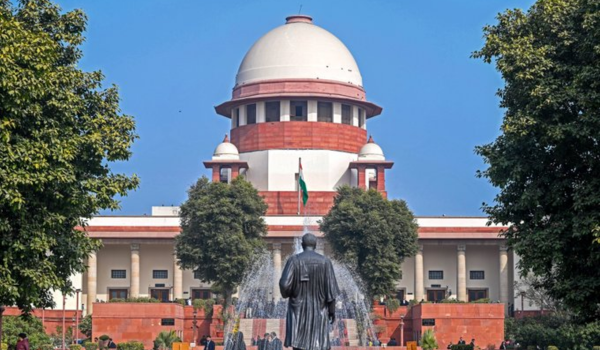

Court said it was important to ensure “fairness in adjudication of genuineness of documents” that would determine inclusion and exclusion of voters. In an unprecedented move, the Supreme Court on Friday decided to depute judicial officers in West Bengal to adjudicate claims of voters listed under the “logical discrepancy” category in the ongoing special intensive revision (SIR) exercise, acknowledging that this was an extraordinary decision in view of the extraordinary circumstances.
A three-judge bench led by Chief Justice of India Surya Kant noted the “trust deficit” and an “unfortunate blame game” between the elected state government and the Election Commission of India (ECI) and underlined the significance of completing the SIR exercise before the state elections a few months later. “We are left with hardly another option but to request the chief justice of the Calcutta high court to spare some serving judicial officers, along with former judicial officers with impeccable integrity, in the rank of additional district judge or district judge, who can then, in each district, be requested to revisit or dispose of claims under the category of logical discrepancy,” the bench comprising justices Joymalya Bagchi and Vipul M Panchol said.
“The circumstances being extraordinary, the request for entrustment to judicial officers or former judicial officers is also of an extraordinary nature,” the bench said, noting that it was important to ensure “fairness in adjudication of genuineness of documents” that would determine inclusion and exclusion of voters in the state’s electoral roll. SIR was rolled out in Bengal on November 4, 2025. The draft electoral roll, published on December 16 last year, excised 5.8 million, and another 11.6 million were flagged under the controversial “logical discrepancy”. ECI has conducted 660,000 hearings, and the final rolls are set to be published on February 28.
The bench referred to the back-and-forth between the state government and the ECI over providing eligible officers to adjudicate claims/objections submitted by close to 13.6 million voters. “There is an unfortunate blame game, allegations and counter allegations which clearly depict a trust deficit between two constitutional functionaries, namely a democratically elected government in the state and the ECI.”
The top court has left it to the discretion of the Calcutta high court’s chief justice to work out a mechanism. On Saturday, the chief justice will hold a joint meeting with the state chief secretary, director general of police (DGP), officials of ECI and the state’s advocate general along with additional solicitor general concerned. “They shall put up respective proposals as to how to remove the stalemate to complete the pending process,” the bench said. “Our only anxiety is that work (of SIR) should commence and be completed without hindrance.”
The bench said that each such serving or former judicial officer will be assisted by the micro-observer appointed by ECI and the officer of the state government deputed to perform such duty, The Superintendent of Police and district collector were directed to be under “deemed deputation” to ensure compliance with the court order and provide all logistical assistance to the judicial officers and their team for smooth and early completion of the adjudication process.
While the state government asked that the process be completed before February 28, the bench said it did not wish to “punish” the judicial officers, considering the volume of work at hand. The court has allowed ECI to publish the electoral roll to the extent it is complete by February 28, and to publish subsequent lists later, since adjudication is an “ongoing process”.
On February 9, the court ordered the West Bengal government to provide Group B officers to the ECI for deputation as EROs who could scrutinise the claims of voters under logical discrepancy and those who are unmapped based on the last SIR conducted in the state. For this purpose, the state undertook to supply a list of 8,505 officers.
But on Friday, senior advocate Dama Sesadari Naidu, who appeared for the ECI, told the court that the state government responded to its request for officers on February 17, stating that the issue was being taken up with the state’s chief electoral officer. Senior advocates Kapil Sibal and Menaka Guruswamy, appearing for West Bengal government, informed the court that the list has already been shared with the poll panel.
Naidu said the list prepared by the state government did not meet the rank and profile required for ERO/AERO, even as Guruswamy pointed out that the state has only 69 sub-divisional rank officers.
