

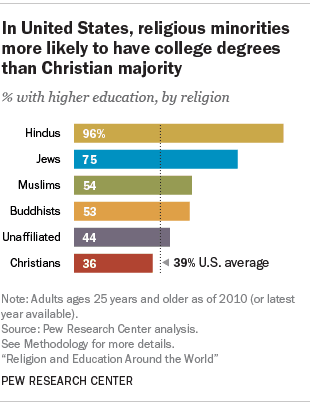

Report noted immigration patterns explain the numbers; Among Hindus, Muslims and Buddhists, many came to US through education or work visas. A new study has found that Hindus are the most highly educated religious group in the United States, followed by Jews. The analysis listed Muslims, Buddhists and Orthodox Christians among religious groups with above-average levels of higher education. That means more than four in 10 adults hold at least a bachelor’s degree in these communities.
Washington-based think tank Pew Research Centre examined education levels of America’s major faith communities. It said the findings of the 2023-24 Religious Landscape Study (RLS) are one of the most comprehensive surveys of religion and public life in the US.
Hindus: Seven-in-ten Hindus (70%) in the US have a bachelor’s degree or more education Jews: The number is 65% for Jews, as per the Pew study.
US national average: Among all adults in the US, only 35% have a bachelor’s degree or higher. Other religious groups: Among those with above-average levels of higher education are Muslims, Buddhists and Orthodox Christians. Mainline Protestant Christians were also found to be above the national average.
At the lower end: By contrast, the share of college graduates among Evangelical Protestants, Catholics and members of historically Black Protestant churches was lower than the national average, the study said. There were a total of 36,908 respondents to the Religious Landscape Study of US adults that was conducted between July 17, 2023 and March 4, 2024, and the report released on February 19, 2026.
As of the most recent estimates from 2024, Hindus, Muslims and Jews each make up a small percentage of the total US population, generally around or under 2% each. Approximately 2% are Jewish, 1%–1.3% Muslim, and 0.5%–1% are Hindu, with the majority of Americans identifying as Christian or religiously unaffiliated.
The report noted that immigration and demographic patterns help explain these numbers. Particularly among Hindus, Muslims and Buddhists, many came to the US through higher-education or skilled-worker visa pathways, it said. These minority faiths are growing, but they remain small proportions of the overall US population compared to the roughly 70% who identify as Christian.
