

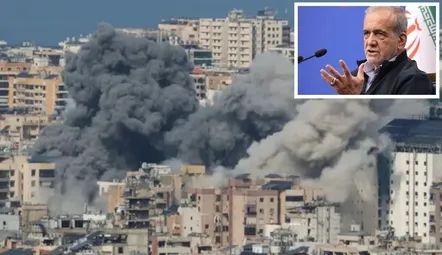

Iran’s President Masoud Pezeshkian said on Saturday that its temporary leadership council had approved the suspension of attacks on neighbours with a condition. In the first major step towards de-escalation, Iran’s President Masoud Pezeshkian on Friday apologised to neighbouring countries and announced a key decision by the country’s interim leadership council that Tehran will not carry out missile strikes or attacks against neighbouring states unless an attack on Iran originates from their territory.
A possible attempt by Tehran to ease regional tensions amid the ongoing conflict sparked by US-Israel strikes on Iran last weekend that killed Iranian Supreme Leader Ayatollah Ali Khamenei and hundreds of others. Follow live updates on US-Iran ‘war’ here Iran’s President Masoud Pezeshkian said on Saturday that its temporary leadership council had approved the suspension of attacks. “I must apologise on my own behalf and on behalf of Iran to the neighbouring countries that were attacked by Iran,” he said. Pezeshkian, however, said added that his country will not surrender to Israel and the United States.
“The enemies must take their wish for the surrender of the Iranian people to their graves,” Pezeshkian as saying, in a speech broadcast on state TV. This comes as parts of the Gulf, including glittery cities of Dubai and Abu Dhabi in United Arab Emirates (UAE), continued to hear explosions and sound missile alerts along with air raid sirens, intercepting drones-missile salvos as part of Iran’s retaliation to the US-Israel joint strikes. Operations at the Dubai International Airport were suspended on Saturday after what was officially reported as a “minor incident”. The Dubai Media Office issued a statement on behalf of the city-state, saying: “For the safety of passengers, airport staff, and airline crew, operations at Dubai International (DXB) have been temporarily suspended.” It did not give a reason for the suspension, which came after passengers there heard a loud boom while sheltering.
The US-Israel strikes – that began on February 28 – and Iran’s counter-fire has led to hundreds of deaths, thousands of flight cancellations due to the airspaces across the Gulf closing and missiles as well as drones targeting US bases and other facilities across Qatar, Bahrain, Saudi Arabia, Kuwait apart from the United Arab Emirates (UAE). Meanwhile, Israeli warplanes pounded Tehran and its ally Lebanon with missiles. The death toll has risen to at least 1,230 people killed in Iran, and over 200 in Lebanon and around a dozen in Israel, according to an Associated Press report, which cited officials. Six US troops were reported killed.
