

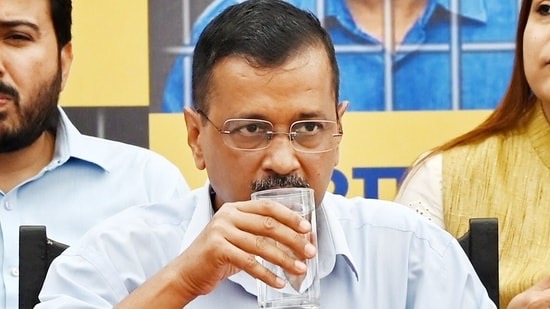

Delhi excise policy case: Delhi’s Rouse Avenue Court denied interim bail to chief minister Arvind Kejriwal. The Rouse Avenue Court in Delhi on Wednesday dismissed an interim bail plea moved by Delhi chief minister Arvind Kejriwal seeking seven days bail for medical reasons. Arvind Kejriwal is lodged in the Tihar jail in a money-laundering case linked to the now-scrapped Delhi excise policy. The Rouse Avenue court extended the judicial custody of Arvind Kejriwal, who was produced virtually before the court, till June 19. The court also directed the concerned authorities to conduct required medical tests of the Aam Aadmi Party chief. The court is scheduled to take up on June 7 Arvind Kejriwal’s application seeking default bail in the case. Kejriwal, arrested in March, was granted a temporary, three-week bail to campaign in the Lok Sabha elections 2024 that concluded on June 1 and he returned to pre-trial detention the following day. On Sunday, the Rouse Avenue Court sent Arvind Kejriwal to judicial custody until June 5. Duty judge Sanjeev Aggarwal noted that Arvind Kejriwal had surrendered to Tihar Jail following Supreme Court directions. The court was hearing an application from the Enforcement Directorate seeking judicial custody of the Delhi chief minister. The application was pending as Arvind Kejriwal was on interim bail. The court took up an application filed by ED seeking an extension of judicial custody by a period of 14 days. The ED had moved the application on May 20, while Kejriwal was out on interim bail granted to him by the Supreme Court. On June 1, the court had reserved the order on a fresh interim bail plea moved by Arvind Kejriwal seeking seven days of bail. On April 9, the Delhi high court dismissed his plea for release from jail and rejected his argument of political vendetta amid the looming Lok Sabha elections. On June 4, the Supreme Court refused to entertain AAP leader Manish Sisodia’s bail pleas in the cases lodged by the CBI and the ED in connection with the alleged Delhi liquor policy scam. The apex court, however, said Sisodia can revive his petitions for bail after the ED and the Central Bureau of Investigation or CBI file their final prosecution complaint and charge sheet, respectively, in the cases involving alleged corruption and money laundering. A prosecution complaint is the ED’s equivalent of a charge sheet.
Trending
- Ex-India opener takes potshots at Riyan Parag’s appointment as Rajasthan Royals captain: ‘He’s treated like king’.
- ‘Restrain the Israelis first’: Joe Kent, who quit as Trump’s aide, on US President’s climbdown on Iran war.
- Psychiatrist shares ‘4 supplements that can naturally boost dopamine’.
- Trump reacts to ‘terrible’ LaGuardia airport crash as Canadian PM breaks silence: ‘They made a mistake’.
- What’s happening on US-Iran ‘talks’ as Trump makes big claim but Tehran denies.
- ‘Israel is fighting for you all’: Netanyahu urges global action as he visits missile strike site in Arad.
- Denied poll ticket, former Puducherry minister quits BJP.
- Air India cancels 2,500 flights to West Asia; CEO says airline operating at 30% capacity.
