

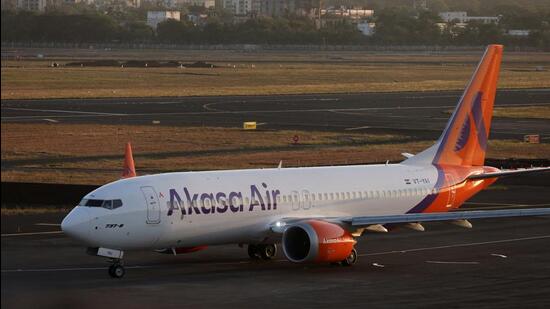

An Akasa Air spokesperson said the flight QP 1361, operating from Bengaluru to Kochi on 29 October, “initiated an air turn back” and landed safely. An Akasa Air flight headed to Kochi on October 29 reversed course and returned to Bengaluru airport due to a fuel imbalance, people familiar with the matter said on Thursday.
“Akasa Air flight QP 1361, operating from Bengaluru to Kochi on 29 October 2025, initiated an air turn back, landing safely in Bengaluru,” an Akasa Air spokesperson said, without revealing what led the pilots to turn back the aircraft.
“At Akasa Air, safety is our highest priority. Our pilots are trained to exercise utmost caution, and an air turn back is a standard precautionary measure. We remain committed to maintaining the highest standards of training, compliance, and operational safety to avoid every such occurrence,” the spokesperson said.
A person aware of the matter said the turn back was carried out due to fuel imbalance, likely to have been a result of an incorrect configuration of cockpit switches. A fuel imbalance refers to an unequal amount of fuel in the tanks on the either side of the aircraft, potentially leading to uneven weight distribution and impacting the plane’s stability.
A second official said the aircraft was immediately grounded for inspection after it returned to Bengaluru. The aircraft, a B737 MAX, continued to be grounded on Thursday.
The incident comes against the backdrop of the civil aviation regulator, the Directorate General of Civil Aviation (DGCA), flagging several concerns in the airline audit, including recurring procedural errors, incomplete documentation, and ongoing systemic shortcomings in crucial areas of flight safety and cabin operations.
These observations were conveyed to the airline in a notice dated October 21, issued after a review of surveillance data from April to September. The regulator classified the lapses as “Level II” safety violations, signifying significant and repeated non-compliance that, while not posing an immediate threat, indicate deeper gaps in safety management and procedural adherence.
