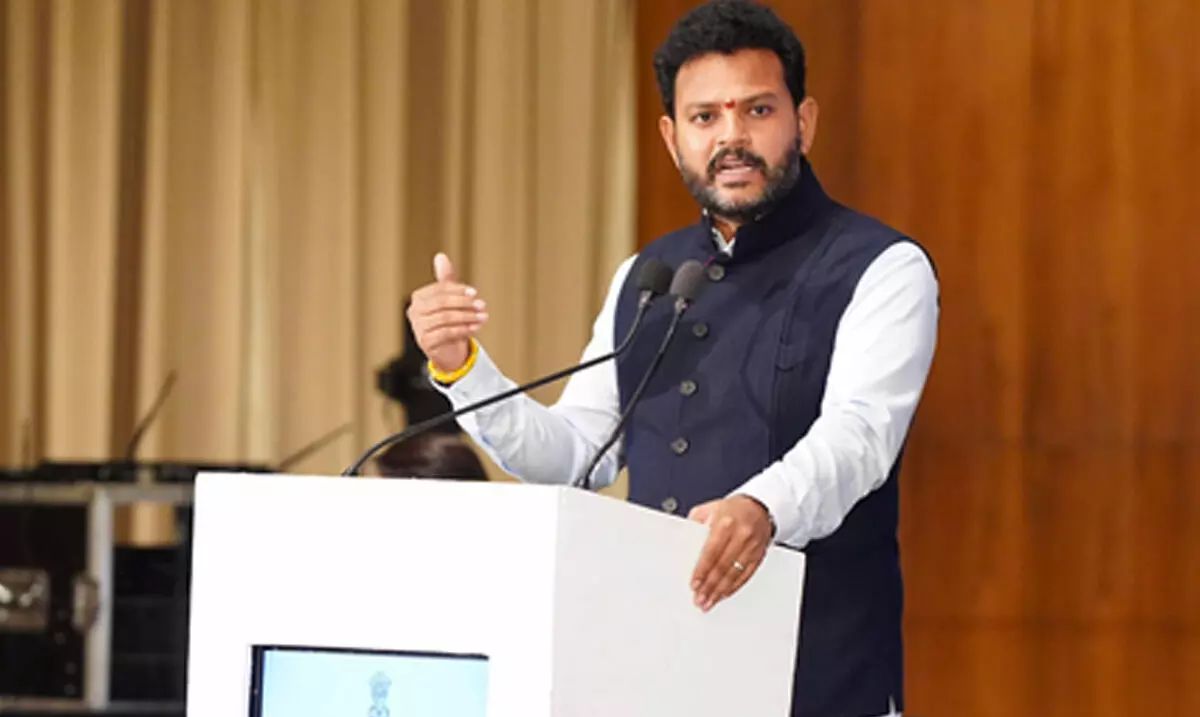

Ram Mohan Naidu cited Covid-19 pandemic, Prayagraj Mahakumbh, Pahalgam attack, and the recent IndiGo crises when the government stepped in to curb airfares. Civil aviation minister Ram Mohan Naidu on Friday spoke in Parliament on the growth of aviation sector, its challenges, and the government’s role during airlines’ crises, including the recent IndiGo disruptions.
While speaking on the subject of government’s measure to regulate airfare, Ram Mohan Naidu said the central government has the power to interfere and cap the fares in cases of “extraordinary circumstances”. The minister, while speaking in Lok Sabha, cited the examples of Covid-19 pandemic, Prayagraj Mahakumbh, Pahalgam attack, and the recent IndiGo crises when the government stepped in to curb soaring airfares.
‘Hawai chappal se hawai jahaz’
The aviation minister’s remark came during a resolution introduced by a member on “appropriate measures to regulate airfare in the country” in Lok Sabha and a week after the IndiGo crisis, where the airline witnessed hundreds of cancellations across major routes in the country. “The slogan ‘Hawai chappal se hawai jahaz’ has been proved right with the way the members here have put up their views. Unless it is connected to the masses of the country, you don’t see that kind of emotion being spoken from members on both the sides. So, that is an example of how deeply and inclusively under the leadership of Prime Minister Narendra Modi, the civil aviation is connected in the country,” Naidu told the lower house.
Speaking of the deregulation in the aviation sector, he said that the deregulation has been there to ensure the aviation sector grows and more players can enter. “We have seen that multiple airlines have come in and multiple challenges for airlines. But the idea still remains that if the civil aviation and aviation sector, if it needs to grow, the first and foremost thing is to keep it deregulated, so that the competition survives and more players can come in,” he said.
However, the minister said that the government cannot cap fares for the entire year, reasoning that the market demand and supply regulate airfares on their own. “When do you observe this airfares rise? It is not that they are rising everyday. When these festive seasons are there, when there is specific demand that originate in this location for most people to travel, like Kerala during Onam. There is a specific season and specific routes in which the airfares are rising because of the demands that originates… These are all specific seasons, it is not that I can cap fares for an entire year to a certain sector. Market demand and supply naturally regulate airfares on their own,” the minister said.
The statement comes days after IndiGo, with domestic market share of over 65 per cent, cancelled hundreds of flights starting from December 2, leading to chaos across major airports in the country and causing hardships to thousands of passengers. While speaking of IndiGo crisis, Naidu blamed a capacity constraint for the widespread disruption and said that the government rushed an order to introduce a cap amid rising airfares.
“There was a capacity constraint, there were many cancellations, there were many routes where the airlines were not able to operate. It was observed that if we don’t interfere, there can be rise in airfares. Immediately we stepped in, we released an order and this time we did the categories based on distance and clearly communicated to the airlines that there has to be capping in airfares,” he said.
While highlighting the government’s view on deregulation in the sector, he said that the Centre however enjoys power to regulate fares in “extraordinary circumstances”. “There is a power with the central government that in extraordinary circumstances, when there is a possibility of misuse of air tariff that we have set up, then there is a power with the central government to interfere, set things right and cap the fares so that the passengers does not experience opportunistic pricing at that time,” he added.
The Ministry of Civil Aviation, in an order on December 6, said airlines cannot charge over ₹7,500 for flights up to 500 km, ₹12,000 for routes between 500 and 1,000 km, ₹15,000 for distance between 1,000 and 1,500 km, and ₹18,000 for above 1,500 km.
