
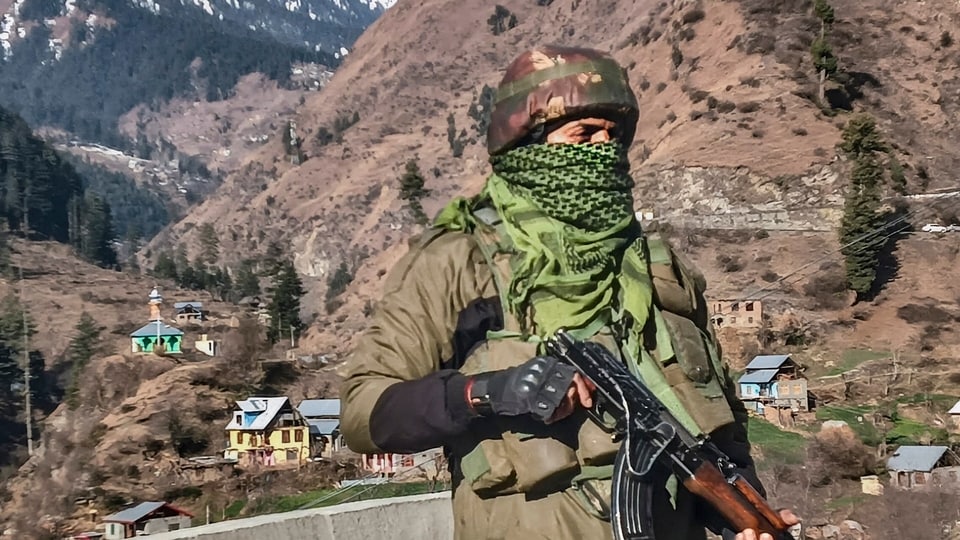

The policy lays out a a multi-layered strategy, aimed at denying terrorists, their financiers and supporters access to funds, weapons and safe havens. The Ministry of Home Affairs (MHA) on Monday unveiled India’s first comprehensive counter-terrorism policy, highlighting the country’s “zero tolerance” and suggesting ways of intelligence-led prevention in the digital age. The policy, named ‘Prahaar’ (Hindi for ‘attack’), lays out a a multi-layered strategy, aimed at denying terrorists, their financiers and supporters access to funds, weapons and safe havens.
This happened to come a day after the Indian Army, along with the Jammu and Kashmir police and the CRPF, neutralised three terrorists in Kishtwar district. One of the slain terrorists has been identified as notorious commander Saifullah. The ministry, in its document for the policy, stated that India has had a “history of sporadic instability” in its immediate neighbourhood.
“India has always stood by the victims of terrorism and has been steadfast in its belief that there can be no justification whatsoever, for violence in the world,” it said, while reiterating India’s ‘zero tolerance’ policy.
What is PRAHAAR?
The ministry has clearly stated the ideals that the counter-terrorism strategy is based on. These include prevention, responses, aggregating internal capacities, and more.
In line with these, PRAHAAR as an acronym stands for:
P: Prevention of terror attacks to protect Indian citizens and interests
R: Responses, which are swift and proportionate to the threat posed;
A: Aggregating internal capacities for achieving synergy in a whole-of-government approach;
H: Human rights and ‘Rule of Law’ based processes for mitigation of threats;
A: Attenuating the conditions enabling terrorism, including radicalization;
A: Aligning and shaping the international efforts to counter terrorism;
R: Recovery and resilience through a whole-of-society approach.
Centre cites cross-border ‘sponsored terrorism’
In its document, the ministry said few countries in the region have sometimes “used terrorism as an instrument of State Policy.” It said that India has been affected “by sponsored terrorism from across the border”, mentioning “jihadi terror outfits” and their frontal organisations.
However, MHA clarified that “India does not link terrorism to any specific religion, ethnicity, nationality or civilization.” It said the India had always denounced terrorism and its use by anyone.
MHA flags dangers of ‘dark web’, ‘crypto’
The ministry mentioned terrorist groups like the Al-Qaeda and the Islamic State of Iraq and Syria (ISIS), saying extremists operating from foreign countries have conspired to promote terrorism. “Their handlers from across the border frequently use latest technologies, including use of Drones, for facilitating terror-related activities and attacks in Punjab and Jammu and Kashmir,” the ministry stated.
It said that the terror groups were using social media and “instant messaging applications” for “propaganda, communication, funding and guiding terror attacks.” The ministry highlighted that these groups “operate anonymously” by using technological advancements “like encryption, dark web, crypto wallets etc.”
