
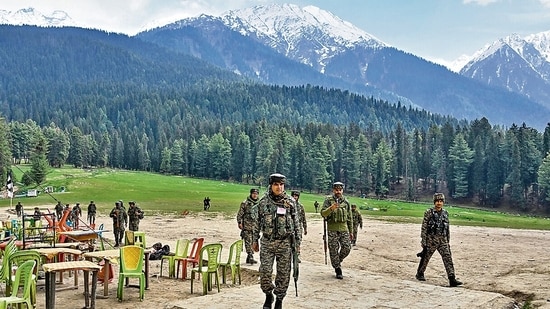

The chargesheet has been filed within the statutory 180-day deadline from the date of the first arrest (June 22) in the terror attack case. The National Investigation Agency (NIA) on Monday chargesheeted six accused in the Pahalgam terror attack. The chargesheet comes seven months after the ghastly attack in J&K’s Pahalgam, in which 26 civilians were killed.
In the 1,597-page chargesheet, the NIA has detailed Pakistan’s involvement in the Pahalgam conspiracy. Banned terror outfits Lashkar-e-Taiba (LeT) and The Resistance Front (TRF) have also been named for their role in planning, facilitating and executing the attack, the agency said in a statement, describing it as “religion-based targeted killings”. The chargesheet has been filed within the statutory 180-day deadline from the date of the first arrest (June 22) in the terror attack case.
Who are the terrorists named in the NIA chargesheet?
Four terrorists, including Pakistani handler terrorist Sajid Jatt, have been named in the chargesheet which was filed before the NIA Special Court in Jammu. The other three terrorists are Faisal Jatt alias Suleman Shah, Habeeb Tahir alias Jibran and Hamza Afghani, who were killed by security personnel during Operation Mahadev in Srinagar’s Dachigam area in July this year.
“LeT/TRF, as well as the four abovementioned terrorists, have been charged under relevant provisions of the Bharatiya Nyaya Sanhita (BNS), 2023, the Arms Act, 1959, and the Unlawful Activities (Prevention) Act, 1967. In its chargesheet, NIA has also invoked the penal section against the accused for waging war against India,” the probe agency said.
Two other persons, Bashir Ahmad Jothar and Parvez Ahmad Jothar, have also been named in the chargesheet. The duo was arrested by the NIA on June 22, 2025 for harbouring terrorists and had disclosed the identities of the three terrorists who carried out the Pahalgam attack. They had also confirmed that they were Pakistani nationals affiliated to proscribed LeT terror outfit, NIA said.
the federal agency interrogated over a 1,000 persons during its probe and has collected various technical, forensic evidence to link Pakistan based terrorists to the terror attack. It also found Aadhar cards, photographs and Facebook IDs of certain individuals from the mobile phones of three Pakistani terrorists, who were eventually killed by the security forces in the Dachigam forest on July 28 – after a three month long hunt.
Several end-to-end encrypted communications between the three terrorists – Suleiman Shah, Hamza Afghani alias Afghan and Jibran – and their handler based in Pakistan, who planned and organised the Pahalgam attack, have also been decoded which will form part of NIA evidence in the charge sheet.
Pahalgam attack fallout and Operation Sindoor
The Pahalgam attack brought India and Pakistan on the brink of a war after India launched Operation Sindoor on May 7 as revenge for the civilian killings. Indian forces bombed nine terror camps across the border in Pakistan and Pakistan-occupied Kashmir (PoK) in pre-dawn strikes — in which at least 100 terrorists were killed. It sparked a series of attacks and counter-attacks across the western border, involving fighter jets, missiles, armed drones, and fierce artillery and rocket duels.In one such attack on the night of May 9-10, the Indian Air Force struck targets at 13 Pakistani airbases and military installations. After four days of fighting, military hostilities were stopped on May 10 evening as the two nations reached an understanding.
