

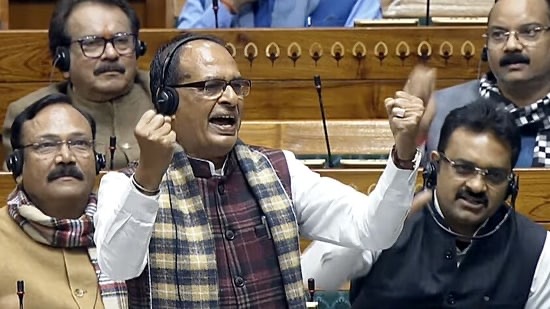

Under MGNREGA, the Centre used to pay 100% of wages. But, the new scheme operates as a Centrally Sponsored Scheme, where all states will bear 40% of the costs. Lok Sabha on Thursday cleared the Viksit Bharat Guarantee for Rozgar and Ajeevika Mission (Gramin) Bill, or simply VB-G RAM G bill, amid a strong protest by the Opposition members.
VB-G RAM G bill, which guarantees 125 days of wage employment to people in rural areas, replaces the UPA-era MGNREGA, that guarantees rural employment. The government has maintained that the latest bill will not only accelerate rural development, but also provide transparency and accountability mechanisms with enhanced security features and administrative provisions.
However, the Opposition has claimed that the new initiative is not only an attempt to remove Mahatma Gandhi’s name, but a measure to dilute the effectiveness of the employment scheme by putting more burden on the state governments, making the scheme ineffective.
What is in new VB-G RAM G bill?
The Centre has asserted that VB-G RAM G Bill will enhance the statutory wage employment guarantee to 125 days in every financial year for unskilled worker, against MGNREGA’s 100 days. Along with bringing in transparency and accountability, the new bill will also empower the gram panchayat and sabha to make plans on what work needs to be undertaken.
Agriculture minister Shivraj Singh Chouhan, who introduced the bill, said the proposed law will lead to “comprehensive development of villages” and “meant to provide abundant employment to every poor person, uphold their dignity, and offer additional protection to the differently-abled, elderly, women, Scheduled Castes, and Scheduled Tribes”.
Chouhan said the bill will focus on water security by creating lakes, micro-irrigation channels, developing core rural infrastructure, livelihood related infrastructure and special works to mitigate extreme weather events. The government has said that the proposed law aligns with the vision of Viksit Bharat and empowers the rural households through increased employment opportunities. However, the Opposition has raised concerns over not just renaming it, but also state’s expenditure, centralised decision-making and dilution of the law.
The Centre has been maintaining that MGNREGA was riddled with corruption during the UPA rule and the expected funds, meant for procuring material, was not used for designated jobs. However, the new bill is not just about corruption of material procurement, there are several changes in guaranteed days, funding pattern, wage payment, along with new provisions like 60-day pause.
While MGNREGA was demand driven depending on availability of worker, the new initiative is supply-driven framework, where the allocations have been capped. Any excess expenditure will have to be borne by the state concerned. The Centre has earmarked ₹ ₹95,000 crore for the initiative.
Under MGNREGA, the Centre used to pay 100% of wages and 75% of the material costs. But, the new scheme operate as a Centrally Sponsored Scheme (CSS), where all the states will bear 40% of the costs, while the North-Eastern and Himalayan States/UT will bear 10% of the costs. The provision of state sharing the costs have specifically been the target of the opposition.
There is also a fresh provision of 60-day mandatory ban during the agricultural seasons to facilitate the availability of farm labour during peak sowing and harvesting seasons.
Four priority areas under new initiative
While MGNREGA was based on water supply, drought proofing and land development, the new initiative is based on four priority areas:
Water security: irrigation support, groundwater recharge, etc
Rural infrastructure: roads, public buildings, school infrastructure, sanitation systems
Livelihood related infrastructure: agriculture, livestock, fisheries
Extreme weather events: Disaster preparedness works like shelters, embankments, flood management structures, etc.
There is also a provision of unemployment allowance, where eligible applicants, who are not provided work within designated time-frame, will be provided an unemployment allowances by state governments.
