

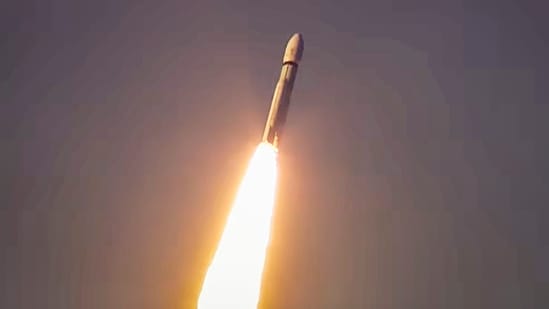

The satellite, weighing 4,410 kg, flew onboard a new-generation, homegrown LVM3-M5 ‘Bahubali’ rocket, enabling ISRO to achieve the rare feat. The Indian Space Research Organisation (ISRO) launched the heaviest communication satellite from Indian soil on Sunday, successfully placing the CMS-03 communication satellite in orbit.
The satellite, weighing 4,410 kg, flew onboard a new-generation, homegrown LVM3-M5 ‘Bahubali’ rocket, enabling the Indian space agency to achieve the rare feat.
The launch took place from the Satish Dhawan Space Centre in Sriharikota, Andhra Pradesh, at 5:26 PM.
ISRO ‘Bahubali’ launch: Top points
The communication satellite CMS-03 was flown on a LVM3-M5 rocket. According to ISRO, CMS-03 is a multi-band communication satellite and would provide services over a wide oceanic region, including the Indian landmass.
ISRO Chairman V Narayanan said the launch vehicle successfully injected the communication satellite into the required orbit. He recalled that the rocket’s previous launch was the “most prestigious Chandrayaan 3, which brought pride to the nation.” He also added that the rocket achieved “yet another pride” on Sunday after succeeding with the “heavier satellite.”
Dubbed as ‘Bahubali’ for its heavy launch capabilities, the LVM3-M5 is a three-stage launch vehicle with two solid motor strap-ons (S200), a liquid propellant core stage (L110) and a cryogenic stage (C25).
All eight LVM 3 launches, including its experimental mission, have been successful, achieving a 100% success rate.
PM Narendra Modi lauded ISRO in an X post, saying “our space sector continues to make us proud”. “Powered by our space scientists, it is commendable how our space sector has become synonymous with excellence and innovation. Their successes have furthered national progress and empowered countless lives,” he said. Union Minister Jitendra Singh also hailed the ISRO and PM Modi for a string of successful space missions.
The satellite is a replacement for the GSAT 7 series, launched in 2013. It was placed in the desired Geosynchronous Transfer Orbit (GTO).
The CMS-03 satellite was designed to provide communication services for at least 15 years. The ISRO scientists faced a challenging time with the mission due to the uncooperative weather, but they still managed to ensure its success.
Prior to Sunday’s launch, the Indian space agency has been utilising the services of the Kourou launch base in French Guiana, using the Ariane rockets offered by France-based Arianespace for launching heavier satellites.
ISRO had launched its heaviest communication satellite, GSAT-11, weighing 5,854 kg, onboard an Ariane-5 VA-246 rocket from French Guiana on December 5, 2018.
The LVM3 vehicle was developed with completely indigenous technology, including the C25 cryogenic stage. It has a track record of successful launches, from the first development flight, the LVM-3 Crew module Atmospheric Re-entry Experiment (CARE), launched in December 2014, ISRO said.
The space agency also revealed that it had planned the human-rated LVM3 rocket, named HRLV, as the launch vehicle for the ambitious Gaganyaan Mission.
